Thursday, 7 April 2016

Interactive Narrative Wk7: Fahrenheit: Indigo Prophecy

1. Of the key narrative elements discussed so far in the course (interactivity, level design/linearity, moral choice/non-linearity, character), which do you think is the most prominent, important
or interesting in your chosen game? 

Fahrenheit: Indigo Prophecy (being the cinematic interactive drama action-adventure that it is) serves as a game that shows the prominent use of a duality between characters and avatars.  The player progresses through the game by controlling a variety of characters all involved within the same narrative, but from different sides of the story. The incentive is to guide each character that you control separately, leading them towards actions that you as the player find befitting of them to progress through the narrative.

I personally found the game's mechanics to be quite clever, in the sense that the actions available for the player to interact with all served their different purposes, regardless of their importance towards the narrative. These actions wittily emphasized the sense of duality in the controlled person being both a character and avatar. Aldred states that "The element of creative choice sets avatars apart from video game characters that can’t be modified and customized, facilitating as it does the creation of a “polymorphous" virtual identity that acts meaningfully on the behalf of the real-world user." For example, I, as Lucas Kane, can decide to hide evidence from a scene so that I do not raise suspicion for myself regarding a murder. Actions like these would be critical in progressing the narrative as they are the major deciding factors of the plot-line, thus declaring Lucas as an avatar in which I, the player, depict my personal decisions in logic and morality through him as a medium. Lucas is not thinking for himself, but rather, I place my judgment within him. On the other hand, there are also those optional actions placed within the environment that cause the characters to perform special actions specific to their relationship with one another, correlating to the situation at hand.  This breathes personality into the characters that the player does not particularly control. A scene I played that shows this is that of Carla Valenti and Tyler Miles, where they are investigating the scene of John's murder. I was able to perform mundane actions such as urinating, washing my hands and drying them - all having nothing to do with the murder scene. According to Tronstad “In role play, the player is more explicitly aware of the character being different from him or herself, having a separate identity with a history, drives, and motivations of its own”. This is particularly when it becomes more apparent.

While there are games that can display a more one-sided use of either avatar or character, Fahrenheit: Indigo Prophecy shows prominent use in its duality with these two elements, showing how a player can feel an effective investment of themselves within a player agent to impact significant changes to the gameplay and narrative, while also being able to experience the rich characters that co-exist within this game's realm.


References:
- Quantic Dream. (Developer). (2005). Fahrenheit: Indigo Prophecy [Video Game]. France: Quantic Dream
- Aldred, J. (Author). (2013) Characters from: The Routledge Companion to Video Game Studies Routledge [Book]. Retrieved from: http://animation.onlearn.co.nz/pluginfile.php/2711/mod_resource/content/0/Characters.pdf
- Tronstad, R. (2008). Character identification in World of Warcraft: The relationship between capacity and
appearance. In H. Corneliussen & J. W. Rettberg (Eds.), Digital culture, play and identity: A World of
Warcraft reader (pp. 249–264). Cambridge, MA: MIT Press.

Interactive Narrative: Character Creation Task

Name of game: Cute Groot (Mobile Phone App Game)

Basic narrative outline of the source material: (in the film) He shows a softer side throughout the film, growing a flower to give to a little girl and saving Drax the Destroyer's life even after Drax's actions brought Ronan the Accuser's forces to them. He agrees with Peter Quill's plan to stand up to Ronan, and later seemingly sacrifices himself to save the rest of the team by enveloping them in a wooden ball grown from himself as Ronan's ship crashes. At the film's conclusion, Rocket has recovered a twig from Groot, which is shown to be re-growing into a miniature Groot.

Basic narrative outline of the videogame:  Rocket has saved Groot! Now, you can help him grow back into the big strong Flora colossus he's meant to be! Take care of your very own miniature Groot! Pet him! Feed him! Customize him! Accessorize him! Watch him dance! Have fun with Cute Groot today! Available on Google Play for Android and IOS.

Role of character in the source material and your videogame: 
Rocket's hired muscle vs. Plant Buddy

Samples of character dialogue (indicate how the dialogue will appear in the game): 


Appearance of the character in  your game (with justifications):
- Groot will look very miniature and young (since he is regrowing from a twig)
- He will have access to all sorts of accessories and clothing (customization!)


NOTES
Negative pointers:
- There isn't much to the character development as the only objective of this game is to keep him satisfied and healthy.
- Narrative progression doesn't exist seeing as how it is a game requiring the player to exist and play within one type of event, and that is to take care of Groot.

Positive pointers:
- The game is simple and appealing. It fits this section of the narrative really well. It's very marketable and suitable for all ages.


Wednesday, 6 April 2016

Cinematic Production: Filming Day & Wrapper Mock-Up

Filming Day

It was a long day today but we managed to film all of the necessary live action shots, background shots and reference shots to progress towards the animation phase of the film.

We brought along Jerwin's friend Robby as he had good filming experience. He provided a lot of the help for the operation of the cameras, lighting, and good suggestions for how we could improve on our shots. With his guidance we learned about quite a lot of things regarding filming:

- We improved on the pacing of the shots to help with the establishing of the setting and the actions occurring.
- A lot of the shots were changed (with the intro for the most part) to better convey certain actions/help with the sense of direction as Michelle moved from place to place and asserted attention towards certain areas.
- Lighting concerning room lighting, inner lighting for the fridge and the spotlight, getting rid of shadows with light bouncing.
- Panning shots to better portray the flow of Michelle's movement from the desk counter to the fridge, as well as the perspective shot to focus attention to the vegetables.

Concerning my work for the day, I did:
- Directorial work. I determined whether the acting concerning movement and speech delivery was up to standard. I looked over pacing (timing, pauses), line delivery (before/during/after an action, emotion and expression),  and shot composition (concerning where she was in the shot and the angle of the shot).
- Support with lighting.
- Filming the blank shots for Butter's environment later on. We determined which shots were the best concerning Butter's line delivery, movement, emotions and what the camera could work with at most considering the space we had to work with (small room, the fridge door and not being able to dismantle the fridge).

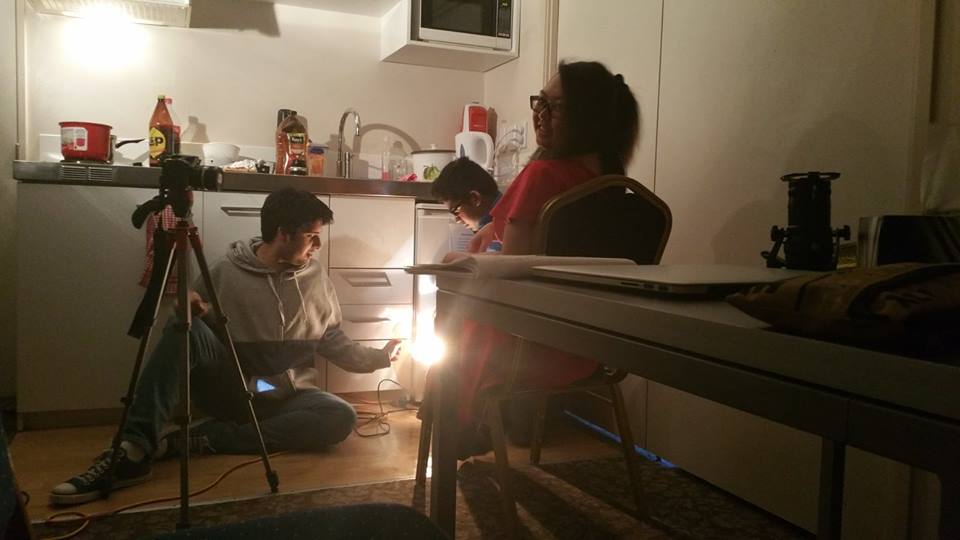
Here are some photos from the shoot:
Lighting


Setting up shot composition and angles


Everyone contributed quite a lot to the filming today in terms of the manual work as well as giving out ideas and suggestions for how to make each shot better. Thank you for all of the hard work!


________________________________________________

As for the wrapper, we managed to measure its dimensions and have made a mock-up of what the design could potentially be. We are going for a posh yet disturbing kind of design, possibly in terms of the text to be found written on the wrapper.


Sunday, 3 April 2016

Cinematic Production: Lighting Test, Wrapper Mood Board & Final Turn-around

Lighting Test

After having taken photos of the inner fridge environment, Jerwin and I decided to do a lighting test with the early butter model inside (without the wrapper). The shot is looking appealing and could be further enhanced with different filters in the future.

EDIT: Keith suggested that the face be drawn more 'bold and rough', looking far more hand-drawn.

Wrapper Mood Board

Details to remember:
- Barcode

- Nutritional information

- Ripped Top Half for Collar: Presley shirt
- Bottom of wrapper curls up + folds at the back for the butt
- Logo

The aim for this wrapper is for it to be gaudy and correlating well with Butter's personality. Very shiny and extravagant. 


Final Turn-Around

2D representation of Butter.


Interactive Narrative Wk6: Fez

1.  As the player, do you interact with a character or an avatar and how does this affect your involvement in the narrative?

Fez is a 2012 indie puzzle platform game in which you play as Gomez: a tiny villager who is bestowed upon a red fez all the while baring sight to a hexahedron that unveils a third dimension to his previously two dimensional world. While I would say that Gomez is both a character and an avatar within this world, I would firmly claim that he is more so the latter. Gomez is at first established to be a character that is an existing member of his village's community, but despite this, Gomez is a character so simple in design and lacking so much dialogue that he doesn't firmly identify to be a strong character with apparent individuality.

The only legitimate interactions I ever experienced between Gomez and another character was with the guide 'Dot'. Apart from the inevitable problem faced by the player in the beginning of the game, any character motivation derives from the player and not Gomez. In fact, because of the lack of interaction, Gomez is left to be a rather inexpressive character, seemingly 'happy' all the time and not having any real change in emotions.

What defines Gomez as a character is essentially what affects the only involvement in the narrative, and that was to establish that there was already a special relationship between the 'Geezer' and Gomez before the player's introduction to the beginning of the game. This Geezer had entrusted this power to be able to see the third dimension to Gomez out of any other candidate, and this relationship between them is his only saving grace in being seen as a character. With this in mind, I can confidently say that Gomez is more of an avatar than a character. As Ragnhild Tronstad says, an avatar is an “extended, prosthetic, part-of-ourselves type of character(s)” that prioritize “embodied empathy, in which the player experiences a kind of physical or bodily connection to the character”. Being a very lackluster character in terms of depth of personality and background, Gomez could instead be seen as a physical means of surpassing the puzzle platformer that is Fez.

References:
- Polytron Corporation (Developer). (2012). Fez [Video Game]. United States of America
- R. Tronstad (Author). (2013). Characters from: The Routledge Companion to Video
Game Studies Routledge. [Article] The Routledge Companion to Video Game Studies

Wednesday, 30 March 2016

Cinematic Production: Animatic Remake + VO Lines

Upon getting feedback for the first animatic, I redrew and edited the animatic to expand on the variation of shots and to better express the emotions necessary. The opening sequence has been fairly reduced to only 3-4 shots to more clearly establish the setting and situation. There are more close-ups for the key lines said by Butter to better highlight the comedic faces he pulls off, as well as a variety of angles that will better accentuate the gradual desperation he experiences in the scene.


I also received some test lines from our hired voice actor who goes by the name 'Mug'. The lines he submitted express the emotions we wanted from the script much better, albeit he wants to redo his lines to meet recording standards as the sound quality isn't too great so far. Here is the preview of the test lines: http://puu.sh/nYIMG/20e67a2e04.mp3

Thursday, 24 March 2016

Interactive Narrative Wk5: Deus Ex

2. Are the “choice situations” in the game obvious or subtle? Do you know the outcomes of your choice prior to making a decision?

Deus Ex is a game where you play as JC Denton to execute missions as a UN Anti-Terrorist operative. Deus Ex was a very risky yet innovative game for its time because it attempted to combine four different video game genres: the apparent first-person shooter and adventure, as well as role-playing and simulation. What established this game as a classic and the best game for its year was the fact that it managed to combine these genres effectively, allowing for great use of player choice within the game. However, the question to ask now is: Were the prompts for choice situations appropriate and were they effective for the player?

Deux Ex's gameplay is like a double-edged sword. Having been dropped into its world, the game clearly established that it would not be holding my hand like in more recent games. Game progression entirely relied upon my choices in how I approached a situation: where I went, how I tackled an obstacle and also my dialogue choices. The positive side of this choice of system is that the player explores the options set within the world on their own, rather than having it laid out for them to progress the narrative in only a linear fashion. This would become the charm of the game in which players are rewarded with surpassing difficulties of their own accord. However, not having a polished establishment on how to progress the game may have its steep downfalls. "In the case of no information, the choice will be completely arbitrary and cannot therefore be made rationally. Also, there cannot be any desire attached to the choice, as there can be no reasonable expectation connected to it, other than those constructed by the agent without any rational basis. Such a choice would hardly be experienced by the agent as a choice at all." With no information being given beforehand, choices will only seem experimental and at times random. This makes the choice situations very subtle in terms of both direct gameplay and dialogue options in which you have no idea what to expect of this world and its NPCs.

With a game such as Deus Ex, its beauty is experienced through discovery with exploration and experiencing everything that the world has to offer on your own, rather than being pulled along by gameplay they guide you through.

References:
- Ion Storm (Developer). (2000). Deus Ex [Video Game]. United States of America: Eidos Interactive
- S. Domsch (Author). (2013). Storyplaying: Agency and Narrative in Video Games [Article]. De Gruyter